
THE HODARI JOURNAL · EDITION 01
The Serengeti Great Migration, month by month
When to go, where the herds are, and what almost nobody tells you.
By Emmanuel Gabriel Samwel (Sam), guide and director of Hodari · Arusha ·
I've spent years answering the same question: “When should I go to see the migration?” The first thing I ask every traveller is what they'd like to see.
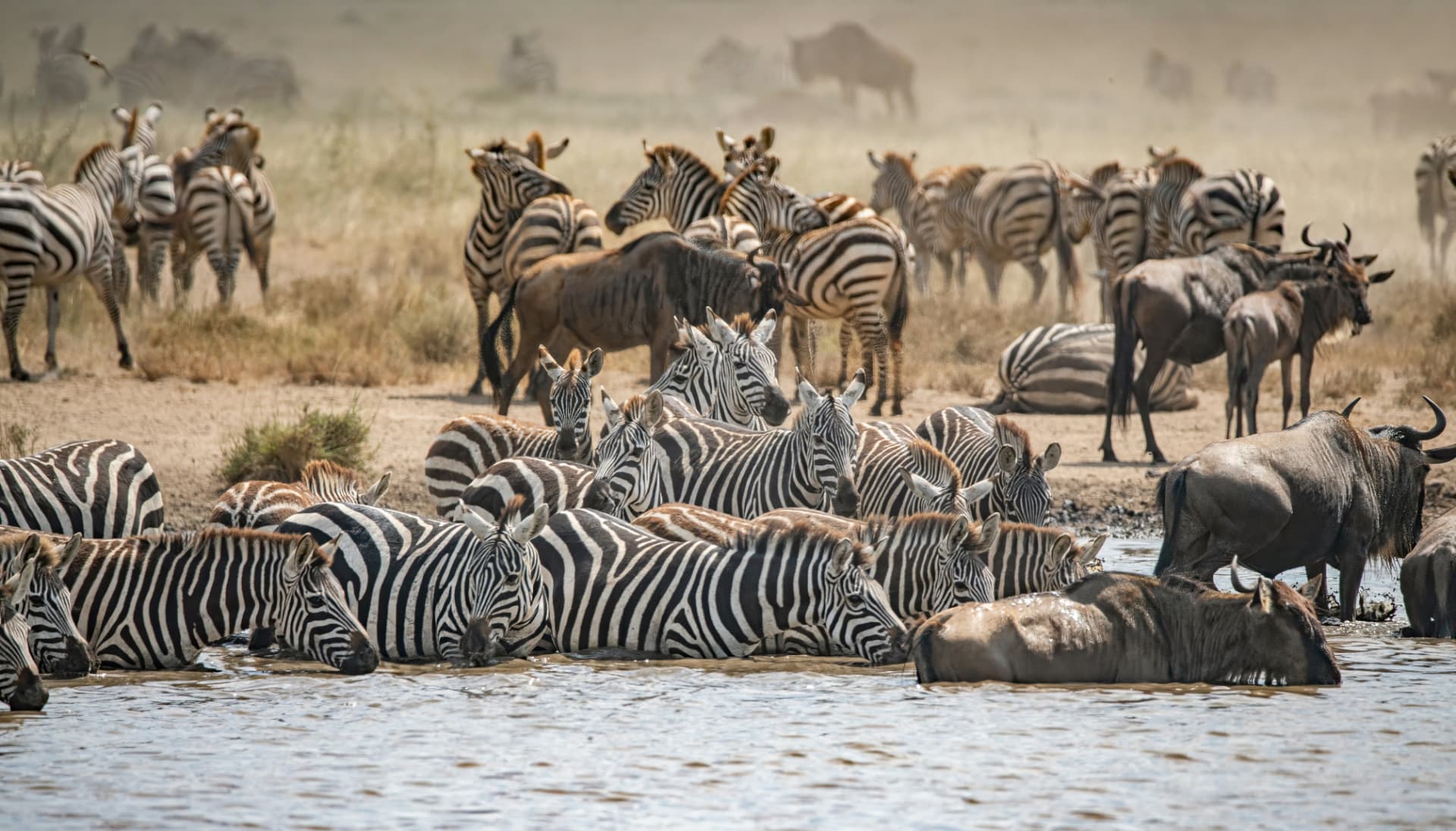
The migration moves all year round. Hundreds of thousands of wildebeest, with zebras and gazelles, travel around 800 kilometres between the Serengeti in Tanzania and the Maasai Mara in Kenya, following the rain and the freshest grass. In February they're in the south, giving birth. In August they're in the north, facing the Mara River. Same animals, two completely different trips.
When is the best time to see the Great Migration?
For the calving, January to March in Ndutu. For the Mara River crossings, July to October in the northern Serengeti.
The herds spend most of the year in Tanzania, so there's something to see in almost every month.
| Months | Where they are | What you'll see |
|---|---|---|
| January – March | Ndutu and southern Serengeti | Calving and predators |
| April – May | Central Serengeti | Great herds on the move, everything green |
| June | West, Grumeti River | First crossings and the rut |
| July – October | North, Mara River | The great crossings |
| November – December | Heading back south | The herds return south with the first rains |
January to March: calving season in Ndutu
According to the African Wildlife Foundation, around 80% of wildebeest calves are born within just two or three weeks, mostly in February. It's no coincidence. The plains of Ndutu, inside the Ngorongoro Conservation Area, are built on volcanic ash, and the grass is rich in calcium and magnesium, exactly what a mother needs to produce milk.
Giving birth all at once is a way to survive: there are so many calves that predators can't take them all. That's why it's the best time to see lions, cheetahs and hyenas in action. And what amazes people most the first time is the speed: a calf is on its feet within minutes of being born and is soon running after its mother.
Calves are born with their eyes open and, for their first few weeks, they're a light tan colour, so they stand out straight away among the adults.
April to June: the rains, the rut and the Grumeti River
April and May are the quietest months. There's more rain, some camps close and the tracks get harder to drive, but the landscape is beautiful and the herds are still there, in the central Serengeti.
In June they reach the Grumeti River, their first big crossing, and the rut begins. Males spend the day chasing each other and calling, and all that noise has a purpose. A 2018 study published in Scientific Reports, with Richard Estes, one of the world's leading wildebeest experts, found that hearing those calls brings the females into season at the same time. Pregnancy lasts around eight and a half months, so what you hear in June becomes the births of February.
July to October: the Mara River crossings
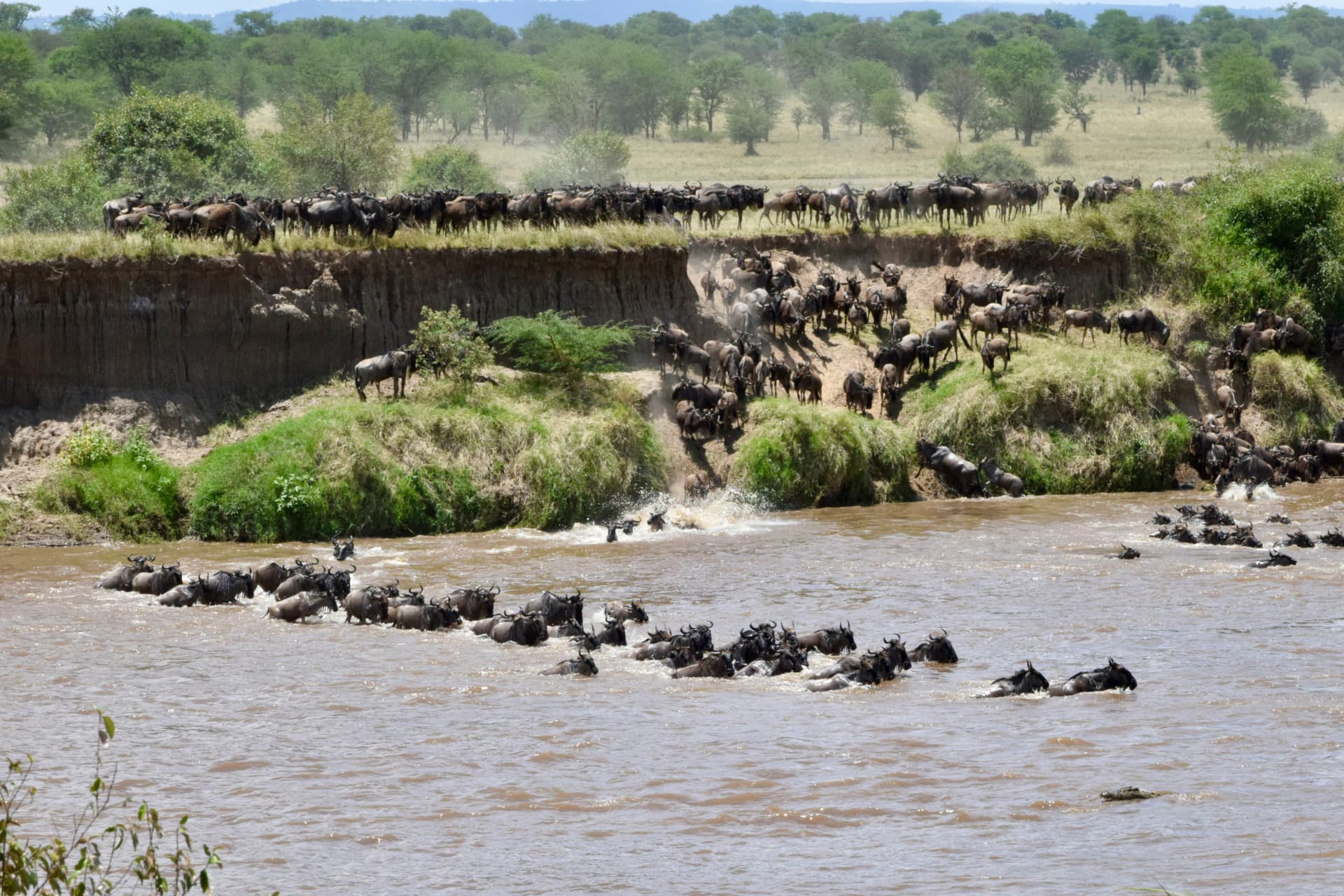
It's the image everyone has in mind: thousands of wildebeest throwing themselves into the water. What few people know is that they don't cross once and move on. They cross in both directions, sometimes several times in a few days, and the dates change every year.
On the Mara, the hard part isn't finding the wildebeest; it's knowing how to wait. A herd can spend hours on the bank and turn back at the last moment. That's why travelling with a private vehicle and guide makes such a difference: we wait at a distance, without hurrying or disturbing the animals, and we stay as long as it takes until they decide to cross.
Our Great Migration journey crosses the Serengeti from south to north and spends two nights by the Mara River.
November and December: the return south
With the first rains of November, the herds move down through the eastern and central Serengeti. By December many are already back in Ndutu, and the cycle begins again.
Three things you might not know
Nobody knows how many wildebeest there are.
Tanzania's 2023 official census, flown by light aircraft, estimated 1.37 million. In 2025, a team from Princeton and Oxford counted them in satellite images and found less than half: between 500,000 and 530,000. Scientists are still debating who's right.
The Mara River lives off the migration.
A study published in PNAS in 2017 calculated that around 6,250 wildebeest drown in the river every year, the weight of ten blue whales. Their bones take around seven years to break down, and all that time they feed fish and bacteria.
Lions don't follow the migration.
Most prides have their own territory and rarely leave it: they wait for the wildebeest to come through. Hyenas are different. When the herds move away, they go after them, however many kilometres it takes, and then return home to their cubs.
Can a crossing be guaranteed?
No. The migration moves with the rain, and no two years are the same. Anyone who promises you a crossing on a specific date isn't telling you the truth. What we do is follow the herds every day and adjust the route to take you where they are.
About the author. Emmanuel Gabriel Samwel (Sam) is a guide in Northern Tanzania and runs Hodari from Arusha.